

Quick Answer: Best Ping Pong Balls in 2026
For competition: Nittaku 3-Star Premium 40+ offers the best overall quality with consistent bounce and ITTF approval, though DHS D40+ provides similar performance at lower cost.
For training: JOOLA 3-Star Training Balls (60-pack) deliver the best value for practice sessions.
Budget pick: Gambler P40+ 3-Star balls are ITTF-approved at just $0.75/ball.
The best table tennis ball in 2026 is the Nittaku 3-Star Premium ball. It may be the most expensive, but the price is warranted. The ball feels hard, has a consistent bounce, and comes from top table tennis brand Nittaku, which has been leading ball popularity for some years now.
Based on my testing, the best ping pong balls in 2026 are:
- Nittaku 3-Star Premium ball — Best Overall
- DHS ABS D40+ 3-Star ball
- JOOLA Prime 3-Star ABS ball — Superb Value for Money
- Butterfly R40+ 3-Star ball
- Gambler P40+ 3-Star ball — Cheapest Match-Quality Ball
But these are just the top balls designed for competitive play. What about the rest? In this post, I cover the top training balls too, along with a guide to help you decide which balls are best for you.
Quick Comparison: Top 6 Competition Balls
| Ball | Price/Ball | ITTF Approved | Best For | Durability | Rating |
|---|---|---|---|---|---|
| Nittaku Premium 40+ | $4-5 | ✓ Yes | Tournaments, serious players | Excellent | ★★★★★ |
| DHS D40+ | $3-4 | ✓ Yes | Competition, best value | Excellent | ★★★★★ |
| JOOLA Prime | $2-3 | ✓ Yes | Club play, training | Very Good | ★★★★½ |
| Butterfly R40+ | $3-4 | ✓ Yes | Tournament play | Very Good | ★★★★½ |
| Gambler P40+ | $0.75 | ✓ Yes | Budget competition | Good | ★★★★ |
| Nittaku Nexcel | $3-4 | ✓ Yes | Orange ball preference | Excellent | ★★★★½ |
Best Ping Pong Balls for Competition
#1 Nittaku 3-Star Premium 40+ Ping Pong Balls (Pack of 3/12) — Best Overall

Key Specifications
- Classification: 3-star
- Material: Plastic (40+)
- Color: White
- ITTF approved: ✓ Yes
- Pack Sizes: 3, 12 balls
- Price: ~$4-5 per ball
✓ Pros
- Exceptional roundness and consistency
- Hard feel preferred by competitive players
- Excellent durability for plastic balls
- Used in 13 World Championships and 3 Olympic Games
- Made in Japan with strict quality control
✗ Cons
- Premium price point ($4-5 per ball)
- May be overkill for casual recreational players
Nittaku Premium 40+ balls have consistently topped ping pong ball ratings from the table tennis community since before the introduction of plastic balls in 2014. They’re made in Japan, are ITTF-approved, very durable, and have a great reputation for their roundness and consistent bounce.
I notice a significant difference when I play with these balls, as they’re more accurate and less wobbly than cheap balls.
The only downside is that they are pretty expensive, but if you’re looking for the most professional ping pong ball you can get then most will agree the Nittaku 3 Star Premium ball is the one you want.
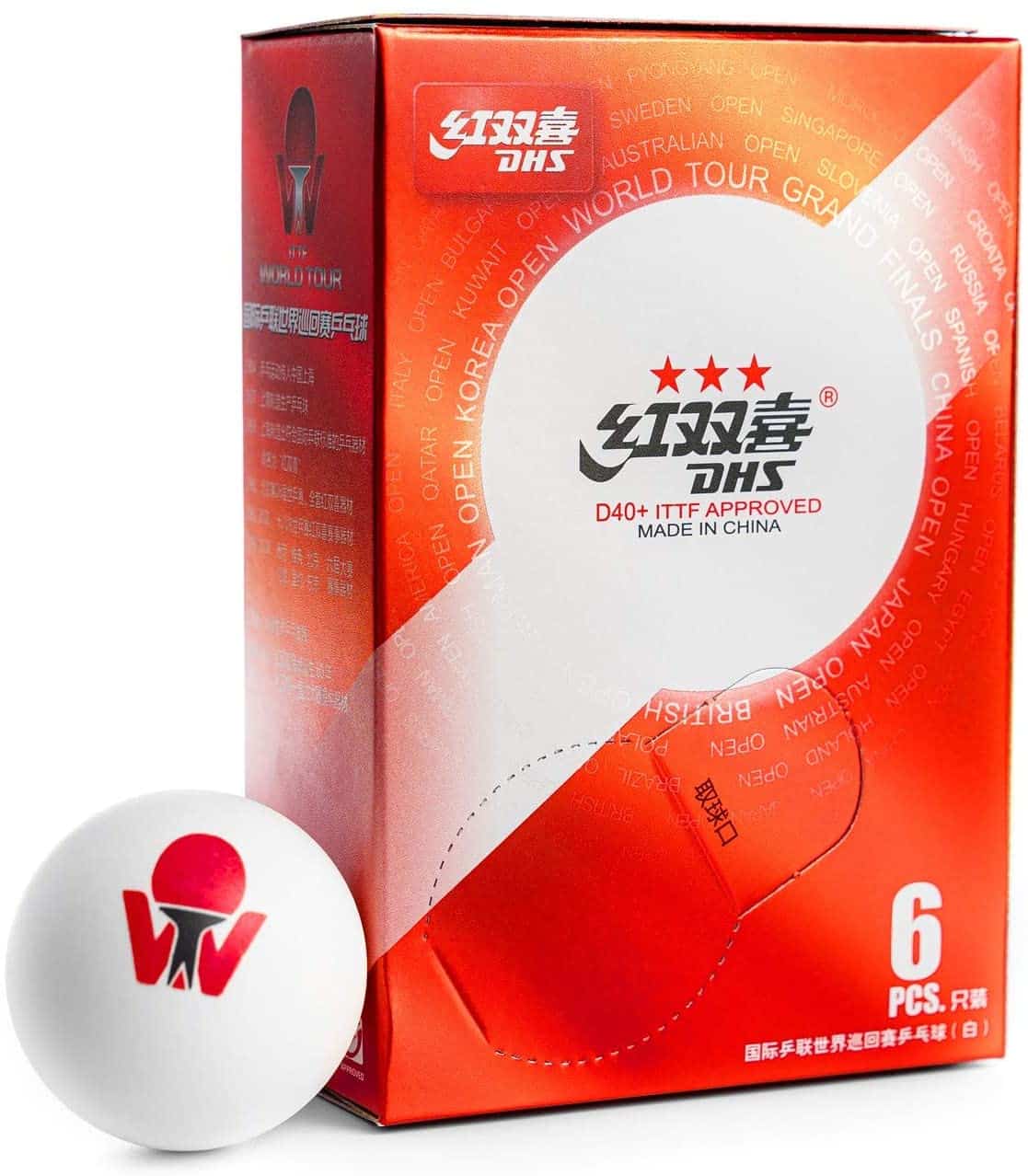
#2 DHS ABS D40+ 3-Star Balls (Pack of 20)
Key Specifications
- Classification: 3-star
- Material: Plastic (ABS)
- Color: Orange and white
- ITTF approved: ✓ Yes
- Pack Size: 20 balls
- Price: ~$3-4 per ball
✓ Pros
- Used at World Championships (2017-2020)
- Very consistent bounce and performance
- Available in both orange and white
- Slightly cheaper than Nittaku Premium
- Excellent value for tournament-quality balls
✗ Cons
- Only available in packs of 20 (larger upfront cost)
DHS ABS D40+ are among the most common table tennis balls used at international events. They were used as the official ping pong ball for the World Championships for four years running from 2017 to 2020.
I’ve always enjoyed using DHS balls and found them to be very consistent. They were even a staple in my racket case back when celluloid balls were the only ones around. There is no doubt in my mind they are among the best balls you can buy, and as they are marginally cheaper than the Nittaku 3-Star Premium 40+, it’s easy to make the argument that they are the best balls overall.
#3 JOOLA Prime 3-Star ABS Balls (Pack of 6) — Superb Value for Money

Key Specifications
- Classification: 3-star
- Material: Plastic (ABS)
- Color: White
- ITTF approved: ✓ Yes
- Pack Size: 6 balls
- Price: ~$2-3 per ball
✓ Pros
- Excellent thickness and uniform hardness
- Greater durability than many competitors
- ITTF-approved for official play
- Best value in premium competition balls
- Trusted JOOLA brand quality
✗ Cons
- Not used in major international tournaments (less prestige)
These JOOLA Prime 3-Star ABS Balls have excellent thickness, even hardness, and consequently, greater durability. As you’d expect they are ITTF-approved and are a good option if you’re looking for a cost-effective premium competition ball. You can, however, go quite a bit cheaper and still get a 3-star ball, but the manufacturer likely won’t have the acclaim of JOOLA.
#4 Butterfly R40+ 3-Star Balls (Pack of 3/6/12)

Key Specifications
- Classification: 3-star
- Material: Plastic
- Color: White
- ITTF approved: ✓ Yes
- Pack Sizes: 3, 6, 12 balls
- Price: ~$3-4 per ball
✓ Pros
- Official ball of 2021 World Championships
- Third generation design with improved durability
- Made in China with strict testing protocols
- Less likely to crack during edge shots
- Viable for highest levels of play
✗ Cons
- Slightly more expensive than JOOLA Prime
The Butterfly 3-star R40+ marks the third generation of Butterfly’s plastic 3-star balls. Made in China, they undergo strict testing to ensure they are viable for the highest levels of play. Butterfly states that they are also more durable than previous versions, which is a strong selling point given how plastic balls can crack when you edge the ball during looping.
This ball was officially used for the 2021 World Championships — you can’t get any more prestigious than that.
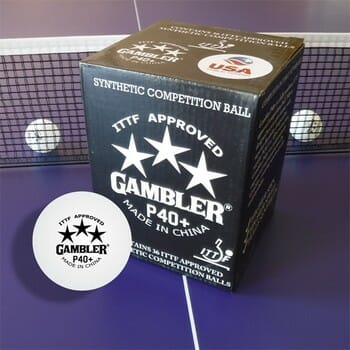
#5 Gambler P40+ 3-Star Balls (Pack of 6) — Cheapest Match-Quality Ball

Key Specifications
- Classification: 3-star
- Material: Plastic
- Color: White
- ITTF approved: ✓ Yes
- Pack Size: 6 balls
- Price: ~$0.75 per ball
✓ Pros
- Incredible value at $0.75 per ball
- ITTF-approved for official play
- Quality similar to balls costing 4-5x more
- Perfect for budget-conscious competitive players
✗ Cons
- Slightly less durable than premium options
- Not used in major international events
If you’re looking for a low-cost ITTF-approved 3-star ball then the Gambler P40+ could be the perfect option. At just $0.75 per ball, they are less than half the cost of the DHS D40+ ball yet they are of similar quality. As a result, I fully recommend them!
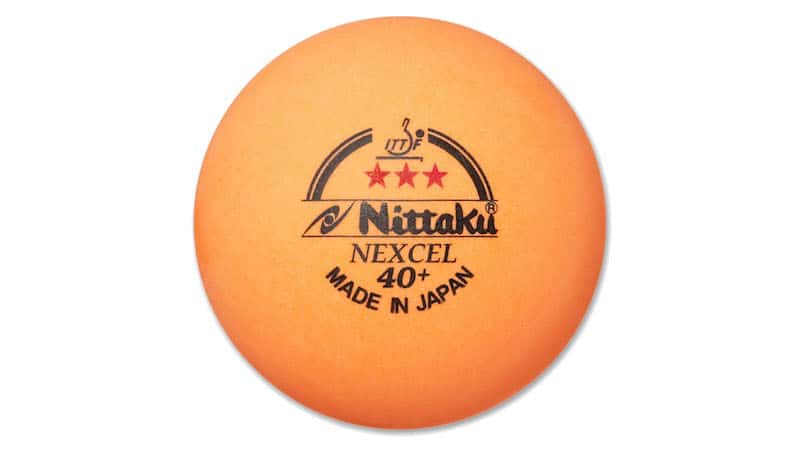
#6 Nittaku 3-Star Nexcel 40+ (Pack of 12)
Key Specifications
- Classification: 3-star
- Material: Plastic
- Color: Orange and white
- ITTF approved: ✓ Yes
- Pack Size: 12 balls
- Price: ~$3-4 per ball
✓ Pros
- First ITTF-approved orange balls
- Much easier to see than white balls
- Made in Japan with Nittaku quality standards
- Very consistent bounce
- Perfect for light backgrounds and bright lighting
✗ Cons
- Premium pricing similar to Nittaku Premium
- Color preference is subjective
If you prefer orange balls to white ones then the Nittaku 3-star Nexcel 40+ balls are one of the best I’ve found. They’re very similar to the Nittaku 3 Star Premium balls as they’re also made in Japan and have a very consistent bounce. They are the first ITTF-approved orange balls and some players much prefer them over white balls as they’re a lot easier to see.
Read More: 19 Ping Pong Gifts That Players Will Love!
Best Training Ping Pong Balls
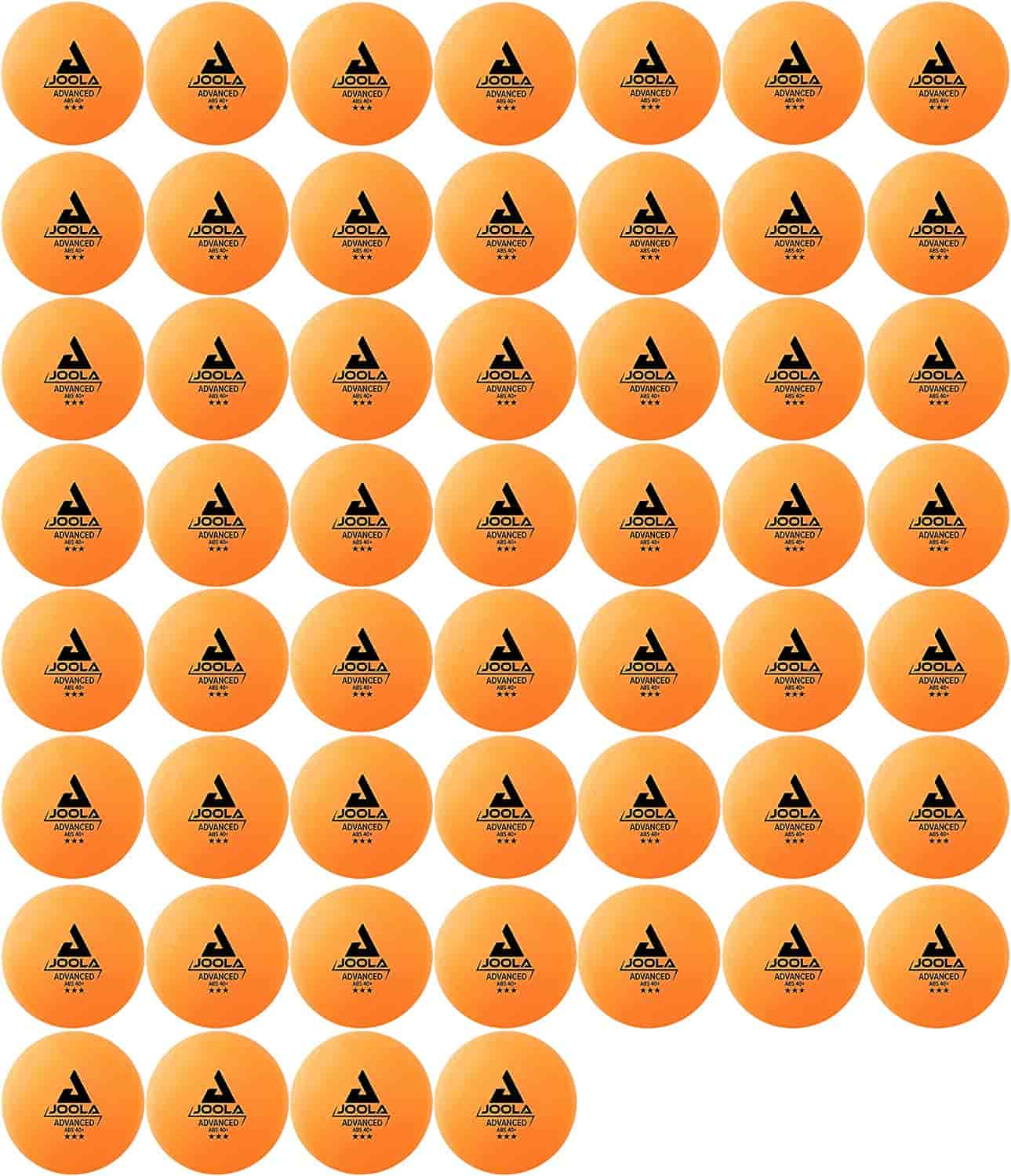
#1 JOOLA 3-Star Training Balls (Pack of 60/120)
Key Specifications
- Classification: 3-star
- Material: Plastic
- Color: Orange
- ITTF approved: No (meets guidelines)
- Pack Sizes: 60, 120 balls
- Best For: Training and practice sessions
✓ Pros
- Remarkably cheap for bulk training
- Available in convenient orange color
- Meets ITTF guidelines (though not officially approved)
- Perfect for robot training
- Greater savings when buying larger quantities
✗ Cons
- Not ITTF-approved (not for official league play)
- Slight quality variation between balls
If you’re after cheap training balls from a reputable table tennis name, you need look no further than the JOOLA 3-star training ball bundle. They are remarkably cheap and come in sets of either 60 or 120. The more you buy, the greater your savings! I like the fact that they are available in orange as there just isn’t enough orange ball availability these days.
While these balls meet ITTF guidelines, they are not officially approved. Therefore they are best reserved for training, your opponents might kick up a fuss if you use them in a local league setting, for instance.
#2 PRO SPIN 3-Star Balls (Pack of 12/24/60)

Key Specifications
- Classification: 3-star
- Material: Plastic
- Color: Orange
- ITTF approved: No
- Pack Sizes: 12, 24, 60 balls
✓ Pros
- Step up from 1 and 2-star training balls
- More affordable than competition balls
- Multiple pack size options
✗ Cons
- Quality not quite as good as specialist brands
- Not ITTF-approved
These balls from PRO SPIN are a good option for those looking for a step up from the 1 and 2-star training balls, but aren’t willing to pay the higher prices of the competition balls mentioned above. The quality isn’t quite as good as some of the other brands but you’ll get a better ball than most produced by non-table tennis specialists.
#3 MAPOL 3-Star Balls (Pack of 50)

Key Specifications
- Classification: 3-star
- Material: Plastic
- Color: White
- ITTF approved: No
- Pack Size: 50 balls
✓ Pros
- Excellent for bulk buying
- Perfect for robot training
- Pretty good value for the price
✗ Cons
- Not competition-standard quality
- Some variation in bounce consistency
If you want to buy some good ping pong balls in bulk for training or perhaps for use in a robot then these balls from Mapol might be a good option. They’ve not got the quality of a competition standard ball but considering the price, they’re pretty good value.
#4 Kevenz 3-Star Balls (Pack of 18/60) — Beginner’s Pick

Key Specifications
- Classification: 3-star
- Material: Plastic
- Color: White and orange
- ITTF approved: No
- Pack Sizes: 18, 60 balls
✓ Pros
- 60 balls for less than one pack of premium balls
- Available in both white and orange
- Perfect for beginners learning fundamentals
✗ Cons
- Lower quality than branded training balls
- Not suitable for competitive play
Another option for bulk buying table tennis balls is this bundle from Kevenz. You get 60 balls for less than the cost of one pack of premium competition balls. Pretty good if you ask me!
Ping Pong Ball Buying Guide
What things do you need to look for in the best table tennis ball? Below I’ll cover everything you need to know when looking to buy some new balls.
Ping Pong Ball Star Ratings: What Do They Mean?

Table tennis balls are given a number of stars from 1 to 3. Balls with 3 stars are of the best quality ping pong balls and are the most durable, while 1-star balls will break or lose their shape quicker. Novelty balls, toy balls, beer pong balls, and table tennis balls intended for children often don’t have any stars at all.
It’s important to know that these star ratings are not official or standardized. Each manufacturer assigns its own star ratings, so stars aren’t an independent measure of quality. An ITTF-approved stamp is a much better sign of a good ball. These have gone through rigorous tests and meet official ITTF regulations for tournament play. That being said 1 and 2-star balls, are usually much lower in quality than 3-star balls. They are best used for training sessions. Finally, balls without a star rating have no quality assurance, are wildly inconsistent, and are much more likely to get damaged.
ITTF Requirements for Table Tennis Balls
The ITTF has very strict requirements for table tennis balls with small allowances for variation during manufacturing. Competition table tennis balls must conform to these standards:
- The ball should be 40 mm in diameter
- The ball should weigh 2.7 grams
- Table tennis balls must be round
- They must not veer
- They must have a consistent bounce
- They must have a uniform hardness
- They must be of the correct thickness
How to Identify Counterfeit Ping Pong Balls
With the rise of online marketplaces, counterfeit table tennis balls have become a growing problem. Here’s how to spot fakes:
- Price: If it seems too good to be true (premium balls at 50% off), it probably is
- Packaging: Look for misspellings, poor print quality, or missing manufacturer information
- ITTF Logo: Counterfeit balls often have blurry or incorrectly placed ITTF stamps
- Weight: Authentic balls weigh exactly 2.7 grams (use a precision scale)
- Bounce Test: Drop from 30cm onto a table; it should bounce 24-26cm
- Seller: Buy from authorized retailers like Megaspin or reputable table tennis specialty stores
Popular Ping Pong Ball Brands
Here are some of the top brands for table tennis balls, in no particular order:
Nittaku
Based in Japan, Nittaku has been making table tennis equipment since 1920. Many consider their high-quality ping pong balls to be some of the best in the world, and they have supplied competition balls for 13 World Championships, 3 Olympic Games, and 7 years of European Championships.
JOOLA
JOOLA is based in Germany and is one of the brands responsible for the first table tennis tables in the early 1950s. In 2018, American company Sport Squad Inc. acquired them. JOOLA table tennis balls draw consistently high praise from experts and amateurs alike.
DHS
DHS stands for “Double Happiness Shanghai,” and they are one of the largest manufacturers of table tennis balls in the world. Founded in 1959, the company was the official table tennis ball supplier for the 2008, 2012, and 2014 World Championships, as well as the 2016 and 2020 Olympic Games.
Butterfly
Another Japanese brand that’s found in every lineup of top table tennis manufacturers is Butterfly. While only one of their balls made my list, they make several of the top-rated ping pong balls on the market.
How Ping Pong Ball Size Has Changed Over Time

Table tennis was invented in the late 1800s in Victorian England (read more about the history of table tennis here). The first ping pong balls were made out of rubber and cork but some improvised and even played with golf balls or balls of string.
In 1901, Englishman James Gibb was traveling in the United States and discovered some lightweight celluloid balls that he thought would be perfect for playing ping pong. In 1926, the International Table Tennis Federation (ITTF) formed, and competition table tennis balls were standardized as being 38 mm in diameter and made of celluloid.
Over time, advances in rackets made the game faster and faster to play. For the 2000 Olympic Games in Sydney, the ITTF increased the size of the ball from 38 mm to 40 mm. The intention here was to make the ball easier to see for television cameras and slow down gameplay to make the game more entertaining for spectators. You can easily identify these balls by their labeling which specifies 40 mm.
Then in 2014, the ITTF changed table tennis ball material from celluloid to non-flammable plastic. As a result, the balls became slightly larger in diameter than the old celluloid balls which is why you’ll see them labeled as 40+. To learn more, read our post What Are Ping Pong Balls Made Of?
Ball Storage and Care Tips
To maximize the lifespan of your ping pong balls:
- Temperature: Store at room temperature (15-25°C/59-77°F). Extreme heat or cold can affect bounce characteristics
- Container: Use a hard protective case to prevent accidental crushing or denting
- Humidity: Keep in a dry environment. Excessive moisture can affect the plastic
- Avoid Direct Sunlight: UV exposure can degrade the plastic over time
- Separate Match and Training Balls: Save your premium balls for important matches and use training balls for practice
How to Choose the Right Ping Pong Ball
Quick Decision Guide:
- Playing in tournaments? → Choose ITTF-approved 3-star: Nittaku Premium or DHS D40+
- Serious club player? → JOOLA Prime or Butterfly R40+ offer great value
- Budget-conscious competitor? → Gambler P40+ provides ITTF approval at $0.75/ball
- Training/practice only? → JOOLA Training balls (60-pack) or PRO SPIN
- Beginner/casual? → Kevenz 60-pack for learning fundamentals
- Robot training? → MAPOL or JOOLA Training balls in bulk
- Prefer orange balls? → Nittaku Nexcel or DHS D40+ (orange option)
Matching Balls to Your Playing Style
Offensive Players: Look for balls with consistent hardness for reliable speed and spin generation. Nittaku Premium and DHS D40+ excel here.
Defensive Players: Prioritize balls with predictable bounce characteristics. Butterfly R40+ and JOOLA Prime offer excellent control.
All-Round Players: Any ITTF-approved 3-star ball will serve you well. JOOLA Prime offers the best balance of quality and value.
Environmental Considerations
While table tennis balls aren’t the most eco-friendly products (they’re made of non-biodegradable plastic), you can minimize impact by:
- Buying Quality: Premium balls last longer, reducing waste
- Proper Storage: Extending ball life means fewer replacements
- Responsible Disposal: Some recycling centers accept hard plastics, though many don’t accept ping pong balls specifically
- Repair Minor Damage: Small dents can sometimes be fixed with hot water (though this won’t work for competition play)
Conclusion
There are many different types of ping pong balls to choose from and what you need depends on your ability and goals. If you’re playing in tournaments and competitions you’ll want to practice with the best ping pong balls. In this case, I recommend the Nittaku 3-Star Premium 40+. It really is a cracking ball (no pun intended) and is widely considered the best among players. The only issue with it is the cost.
If you would rather save money but still play with a high-quality 3-star ball, I recommend the JOOLA Prime 3-Star ball instead. It is still a great ball and isn’t wildly different from Nittaku’s. I also strongly advise you pick up some training balls to save your wallet. Buy one box of these and you won’t have to think about table tennis balls again for a long time, JOOLA 3-Star Training balls are my favorite in this category.
Enjoy this post? You can learn everything else there is to know about ping pong balls here.
Ping Pong Ball Frequently Asked Questions
What’s the difference between 1-star, 2-star, and 3-star ping pong balls?
3-star balls are the highest quality with consistent bounce, proper roundness, and uniform hardness. They’re suitable for competition and meet strict manufacturing standards. 2-star balls are mid-grade training balls, while 1-star balls are basic practice balls with less consistency. Only 3-star balls are typically ITTF-approved for tournament play. The star ratings are assigned by manufacturers and aren’t officially standardized, so always look for the ITTF approval stamp for true quality assurance.
Are expensive ping pong balls worth it for recreational players?
For casual play, mid-range 3-star balls like JOOLA Prime ($2-3/ball) offer excellent value. Premium balls like Nittaku ($4-5/ball) provide marginal improvements that recreational players may not notice. However, avoid cheap no-star balls as they’ll negatively impact your game development with inconsistent bounce and poor durability. A good compromise: use 1-2 premium balls for matches and training balls for practice sessions.
How long do ping pong balls last?
Quality 3-star balls typically last 10-20 hours of play before showing performance degradation. Competitive players may replace balls after 5-10 hours for optimal consistency. Training balls last longer since minor imperfections matter less. Replace balls when you notice cracks, dents, or changes in bounce sound or feel. Store balls at room temperature in a protective case to maximize lifespan. Proper storage can extend usable life by 50% or more.
Should I buy orange or white ping pong balls?
Choose based on your table and lighting conditions. Orange balls are easier to see against light backgrounds and in bright conditions, making them ideal for sports halls with windows or light-colored walls. White balls work better with dark tables and low lighting. Performance-wise, there’s no difference between the two colors—both meet the same ITTF standards for weight, size, and bounce. Many players keep both colors and choose based on their playing environment.
What ping pong balls do professionals use in 2026?
Professional tournaments rotate between ITTF-approved manufacturers. Recent major events have used DHS D40+ (2017-2020 World Championships), Nittaku Premium (multiple Olympics and World Championships), and Butterfly R40+ (2021 World Championships). The specific ball used varies by tournament and sponsorship agreements, but all top professionals practice with ITTF-approved 3-star balls from these major brands to match tournament conditions. Always check the official tournament website for the specific ball being used.
How can I tell if ping pong balls are counterfeit?
Red flags include suspiciously low prices (50%+ off premium balls), misspelled brand names, missing or blurry ITTF logos, poor printing quality on the ball, inconsistent weight (should be exactly 2.7g), and missing manufacturer information on packaging. Counterfeit balls often have uneven bounce and break easily. To avoid fakes, buy from authorized retailers like Megaspin or reputable table tennis specialty stores. You can also perform a bounce test: drop a ball from 30cm onto a table. It should bounce 24-26cm consistently.
What does 40+ mean on ping pong balls?
The 40+ designation indicates balls made from the new plastic material introduced in 2014, which are slightly larger than the original 40mm celluloid balls (but less than 1mm larger). All modern competition balls are 40+ plastic balls. The “+” distinguishes them from older celluloid 40mm balls, which are no longer manufactured or used in competition due to flammability concerns. The change to plastic also affected the sound and playing characteristics slightly, making the game marginally slower.
Do ping pong balls work differently at high altitudes?
Yes, balls bounce slightly higher and travel faster at high altitudes due to lower air resistance. Players at elevations above 3,000 feet (900m) may notice faster gameplay and more spin. The thinner air provides less resistance to the ball’s rotation and flight path. This is why some high-altitude tournaments may use slightly different balls or why players need an adjustment period. Most players adapt within a few practice sessions, though the difference becomes more pronounced above 5,000 feet.
How do I keep my ping pong balls in the best condition?
Table tennis balls are more robust than they look, but they can still crack if subjected to excessive force. Store balls in a hard protective case to prevent accidental damage from crushing or dropping. Keep them at room temperature (15-25°C/59-77°F) away from direct sunlight and extreme humidity. Avoid leaving balls in hot cars or cold garages, as temperature extremes can affect the plastic and bounce characteristics. Separate your premium competition balls from training balls to preserve the best ones for important matches.
Are there 5-star ping pong balls?
No, there are no legitimate 5-star ping pong balls. The classification system for table tennis balls only goes as high as 3 stars. Any product claiming to be “5-star” is using a marketing ploy to try and fool buyers into thinking their balls are higher quality than legitimate brands. None of these “5-star” balls are ITTF-approved and should be avoided for such deceptive tactics. Stick with properly rated 3-star balls from reputable manufacturers.
What is the difference between orange and white ping pong balls?
There is no performance difference besides the color. Both orange and white balls must meet the same ITTF standards for weight (2.7g), size (40mm), bounce, and hardness. Orange balls are particularly useful in sports halls with light backgrounds or bright lighting, as they’re far more visible than white balls. Many players find it very easy to lose track of a white ball during fast gameplay in brightly lit environments, making orange a practical choice for certain venues.
What ping pong balls were used in the Olympics?
Double Happiness (DHS) has supplied balls for multiple recent Olympics, including Rio 2016 and Tokyo 2020 (held in 2021). The Paris 2024 Olympics also used ITTF-approved balls from a major manufacturer. The specific brand used varies by Olympic Games based on sponsorship agreements and ITTF approval, but all Olympic balls must meet strict ITTF standards and undergo rigorous testing. Professional players practice extensively with the announced Olympic ball in the months leading up to the games.
How often should I change table tennis balls?
You should replace table tennis balls when you notice a crack has formed, which is the most obvious sign. Sometimes you can tell through feel when you’re playing, but most of the time you’ll hear that the bounce sounds different—a cracked ball produces a duller sound. Other signs include visible dents, wobbling during flight, or inconsistent bounce height. For competitive play, consider rotating to fresh balls every 10-20 hours of play even without visible damage, as performance degrades gradually. Training balls can be used longer since slight variations matter less.
Read More: The 10 Best Ping Pong Paddles: Reviews And Buying Guide

Freelance writer. Table tennis enthusiast. Lover of all things online. When I’m not working on my loop game I’m probably binge-watching some fantasy show.